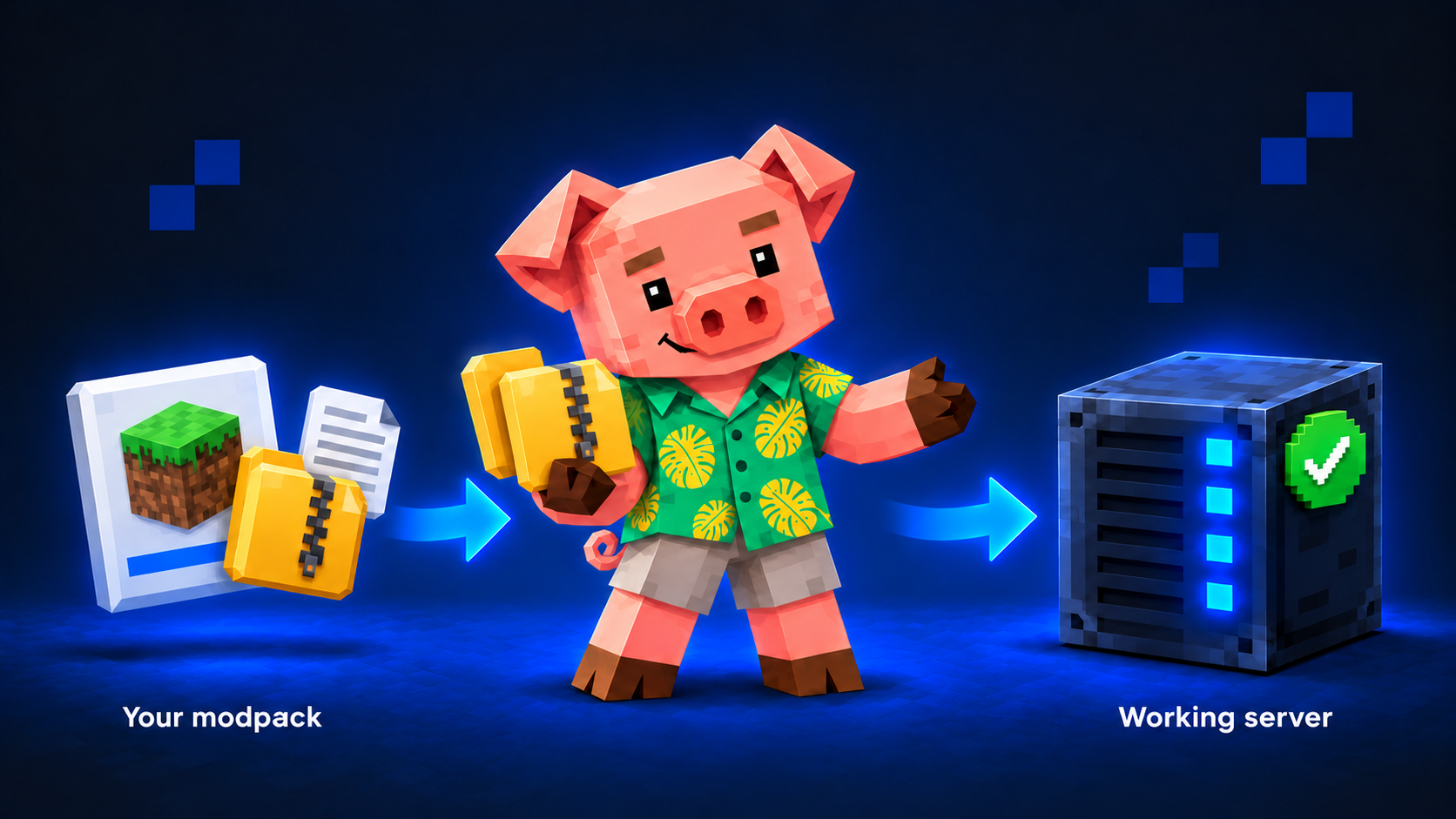
Why Choose Piggo for Your Modded Minecraft Server?

Maksym Savrei
Founder, Piggo
There are dozens of Minecraft hosts selling RAM, Ryzen CPUs, backups, one-click modpacks, and control panels.
Piggo does not exist because Minecraft servers are impossible to host elsewhere.
We built Piggo around a different problem: most people who play modded Minecraft with friends do not actually want to become the server administrator.
They want to choose a pack, invite their friends, and play. They do not want the evening to turn into figuring out why NeoForge refuses to start, whether a mod is client-only, which Java version the pack expects, or whether the server is lagging because it needs more RAM or because one chunk is doing something ridiculous.
That is the difference Piggo is trying to make: not just giving you a server, but taking responsibility for the server side of modded Minecraft.
The short answer: what is actually different about Piggo?
Piggo is managed hosting built specifically around modded Minecraft friend groups.
- Tell us what modpack you want to play and how many friends are joining. We help size the server instead of making you guess first.
- We install and prepare modpacks, including custom CurseForge or Modrinth packs when the server side needs work.
- If the server breaks, the goal is to investigate the actual cause rather than defaulting to "buy more RAM."
- You still get full panel access and SFTP if you want to manage files yourself.
- You can test the service for 48 hours without a card before committing.
- If you only want the cheapest possible gigabytes of RAM and enjoy managing every technical detail yourself, Piggo may not be the right host.
1. Piggo is built around modded Minecraft, not just Minecraft
Vanilla Minecraft hosting is relatively predictable. Modded Minecraft is not.
A server can fail because the pack is using the wrong Forge or NeoForge build. A client-only mod can try to load rendering classes on a dedicated server. A dependency can be missing. A pack can rely on configs, KubeJS scripts, datapacks, or startup settings that never made it to the server. A pack update can change the rules again.
Those are not edge cases for Piggo. They are the normal job.
That is why the site is built around modded Minecraft rather than trying to be a generic game-hosting catalogue. The current service includes modpack installation, personal support from a real person, full panel access, and the ability to switch packs while keeping your world saved.
If you want to see the technical side of this, our guide How to Turn a Custom CurseForge Modpack Into a Minecraft Server (2026) explains why a client profile and a dedicated server pack are not the same thing.
2. You do not need to know how much RAM your modpack needs before buying
One of the strangest parts of buying Minecraft hosting is that the customer is often asked to make the infrastructure decision before they have even played the pack.
Eight gigabytes? Twelve? Sixteen? Is ATM10 actually memory-heavy, or is the real problem world generation? Will three players be fine because they share a base, or will they all build separate factories and keep half the map loaded?
Most players cannot answer those questions before the server exists. They should not need to.
With Piggo, you can tell us the pack and expected player count and we will recommend the starting setup. If the world grows into something heavier later, the plan can change with it.
> "I'd rather pay for overkill than lag." - From a Piggo customer interview, anonymized
That sentence captures the anxiety behind a lot of hosting purchases. People are not trying to optimize a JVM budget. They are trying to avoid being the person who picked the wrong plan and ruined Friday night for the group.
Our RAM guides for Craftoria and All the Mods 10 go into the technical side in more detail, but the important point is the same: mod count alone is a weak sizing metric. Player behavior, exploration, automation, chunk loading, server age, and CPU workload all matter.
3. When something breaks, Piggo is supposed to take ownership
This is the part that matters more than the hardware spec sheet.
A recent trial customer wanted to play the newly released Prominence II 4.0. The server crashed, the normal startup path did not work, and an official server pack was not available yet.
The easy answer would have been: wait until the pack author publishes server files.
Instead, we prepared what was needed on the server side manually, worked through startup, checked that the quests and pack behavior were actually there, and contacted the pack developers when we needed clarification. The customer later came back and paid for the server.
> Customer case - Prominence II 4.0: Trial server → no official server pack available → manual server-side preparation → pack checked for real playability → developer contact where needed → customer returned as a paying user.
That is what "managed" is supposed to mean to us. Not that nothing will ever break. Modded Minecraft will break. The difference is whether you are left alone with the crash log when it does.
Piggo also publishes a one-hour fix promise during support hours: if a covered server problem is not fixed within the hour, the next month is free. The point is not the slogan; it is putting a consequence behind the support promise.
Public customer reviews describe the same thing in simpler language: one customer wrote that they had "near constant support from a real person," while another said they had "completely forgot what crashes and support tickets are."
4. Simple does not mean limited
In one customer interview, a player told us that competing hosting websites felt too "techy." Piggo felt straightforward enough that she could understand what she was buying without first learning the vocabulary of game hosting.
That feedback matters because there is a bad version of simplicity: hiding everything.
That is not the goal.
Piggo customers still have full panel access. You can manage files, use SFTP, edit configs, upload mods, change versions, and get into the technical side when you want to. We even publish guides for doing those things yourself.
The difference is that you should not be forced to understand all of it before you can buy a server.
> "You shouldn't need to understand hosting to buy hosting."
If you are technical, the controls are there. If you are not, you can message us instead.
5. Your three hours of Minecraft should not include one hour of debugging
A lot of the people we speak to are not looking for a server because they want a new systems-administration hobby.
They have work, university, families, and a limited overlap where the whole friend group is actually online at the same time.
One customer explained it very simply: when she gets the chance to play, she needs the server to be online.
That changes what "good hosting" means.
A control panel full of features is not very useful if the group spends the first hour of the evening diagnosing a loader mismatch. A cheap server is not particularly cheap if the person who set it up loses half a Saturday every time the modpack updates.
For us, the useful outcome is boring: the group joins, the server works, and nobody has to become the unpaid IT department for their friends.
6. Custom modpacks are not treated like an edge case
This is one area where we are deliberately leaning harder into the managed model.
If you built your own CurseForge or Modrinth pack, you can send it to us. We can check the loader, server compatibility, dependencies, configs, and first boot, then prepare the server-side setup.
That matters because "works in singleplayer" and "works on a dedicated server" are not the same test. Client-only mods, missing libraries, mismatched configs, and scripts can all turn a perfectly working local pack into a server that crashes before world generation.
You can absolutely solve those problems yourself. We publish technical guides showing how.
But if the reason you bought hosting was to play with your friends rather than build server packs, you can simply send the pack to us.
> Built your own pack? Send it to us and we'll help get the server side running.
7. You can test the actual modpack before paying
Modded Minecraft performance is difficult to judge from a pricing table.
You can compare RAM, CPU names, storage, and marketing claims all day, but the question you actually care about is usually much simpler:
> "Will my modpack run properly with my friends?"
That is why Piggo offers a 48-hour free trial with no card required.
The point of the trial is not to make "FREE" the product. It is to let you test the thing that is hard to know from a spec sheet: your actual pack, your actual server, and ideally the way your group actually plays.
If it is not what you expected, do not buy it.
8. Piggo is not for everybody
This part is important because managed hosting is not automatically the best choice for every Minecraft player.
If all you want is the lowest possible price per gigabyte of RAM, you are comfortable maintaining the server yourself, and troubleshooting Forge or NeoForge sounds fun rather than annoying, Piggo may not be the right fit.
A VPS, dedicated server, or more bare-bones game host can make more sense for someone who wants complete responsibility and mainly cares about infrastructure cost.
Piggo makes the most sense when:
- you are running modded Minecraft with friends rather than operating a public network as a full-time server admin;
- you care about the server being ready when the group has time to play;
- you want somebody to investigate crashes and setup problems instead of handing the problem back to you;
- you are not sure how to size the pack and would rather ask than guess;
- or you have a custom pack and do not want to build the dedicated-server version alone.
That is the customer Piggo is being built for.
What Piggo actually sells
The hardware still matters. Piggo currently runs its Minecraft hosting on Ryzen 9 9950X systems with DDR5 ECC memory and NVMe storage.
But hardware is not the positioning.
| The spec-sheet version | What we want it to mean in practice |
|---|---|
| 8 / 12 / 16 GB RAM | We help you choose a sensible starting size for the pack and group. |
| One-click modpacks | The pack should actually boot and be playable, not merely appear in a dropdown. |
| Support | Someone takes ownership of the server-side problem with you. |
| Custom modpack support | You can send the pack instead of first learning how to turn it into a server pack. |
| 48-hour trial | Test the actual modpack before deciding whether the service is worth paying for. |
| Full panel access | Managed when you want help; controllable when you want to do it yourself. |
Piggo is not trying to make Minecraft hosting more complicated.
The goal is the opposite.
> "You choose what you want to play. We handle the server."
If that sounds like the kind of hosting you want, start the 48-hour trial and tell us the modpack. If you built the pack yourself, send it through our custom modpack hosting page and we will help turn it into a working multiplayer server.
Frequently asked questions
Modded Minecraft hosting, managed
- 48-hour free trial, no card needed
- 1-hour fix guarantee, 08:00-22:00 Amsterdam time
- Daily offsite backups, kept 7 days
Related articles

How Piggo Handles Your Payment Details (And What to Ask Any Host)
We never see or store your card. Here is exactly what happens when you pay, who processes it, what we can see, and how to check we are a real company.
What Actually Happens When Your Modded Minecraft Server Crashes
Modded Minecraft servers crash. Most hosting uptime guarantees don't cover the thing that actually breaks. Here's why, and what we decided to do about it.
Why Friend Groups Stop Playing Minecraft Together (And How to Fix It)
Most Minecraft servers don't die because of lag or crashes. They die because of something much simpler. Here's the real reason friend groups stop playing and what actually helps.